How ESG and Connectivity Are Shaping Resilient Farms
How ESG and Connectivity Are Shaping Resilient Farms Key takeaway ESG should support better on-farm decisions, help manage risk, and show the real value of good land stewardship, rather than
ESG is a framework that can help producers to address sustainability issues, enhance sustainability performance, increase resilience, reduce risks and create opportunities. ESG stands for:
These are factors related to the way you manage renewable and non-renewable resources such as water, soil, biodiversity, minerals, and animal treatment.
These are factors related to the way you interact with your family, employees, communities, consumers, supply chain and business relationships.
These are factors related to your business such as leadership, management, systems, processes, products and controls.
Environmental, Social, and Governance (ESG) is no longer a niche concept. ESG standards are now essential for promoting sustainability in agriculture and creating long-term value in agricultural production.
An ESG assessment offers valuable insights into on-farm risks and opportunities, enabling farmers to become leaders in sustainable practices and distinguish themselves as champions of sustainability.
Help ensure ESG activities reflect real grower priorities and support practical actions that strengthen performance, resilience and access to emerging markets.
A new ESG materiality assessment is underway to update and expand our understanding of the key sustainability issues shaping sugarcane production in Queensland.
The 2023 to 2024 assessment in the Burdekin and Mackay regions showed environmental issues were the top concern. These insights will guide the future of the hub’s ESG work for Queensland’s sugarcane industry.
We have also created a comprehensive workbook to help you learn about ESG and guide you through developing your own detailed ESG analysis.
The “ESG on Farm: Are you Ready?” workbook provides a practical guide to support farmers/primary producers develop their own ESG analysis.
This framework will help you establish a sustainability baseline, measure ESG factors, create an ESG strategy and report on sustainability-related risks and opportunities. It also links to the wider international environmental and social goals under the United Nations Sustainable Development Goals.
We have developed an easy to use, rapid ESG assessment specifically for small business farmers. This tool is designed to help small business farmers quickly adopt ESG standards and enhance their sustainable farming practices.
To complete your ESG assessment, simply fill out the online survey below and provide key information about your production, such as nitrogen application, yield, and herbicide/pesticide use.
Based on your input, we will provide you with:
We have also created a comprehensive workbook to help you learn about ESG and guide you through developing your own detailed ESG analysis.
The “ESG on Farm: Are you Ready?” workbook provides a practical guide to support farmers/primary producers develop their own ESG analysis.
This framework will help you establish a sustainability baseline, measure ESG factors, create an ESG strategy and report on sustainability-related risks and opportunities. It also links to the wider international environmental and social goals under the United Nations Sustainable Development Goals.
An ESG On-Farm Workbook is currently being adapted to suit beef producers and their operations. For more information, contact TNQ Drought Hub Senior Research Officer Ana Leite De Almeida ana.leitedealmeida@jcu.edu.au or 0402 693 448.
What’s the difference between this ESG toolkit and other tools or frameworks in Australia?
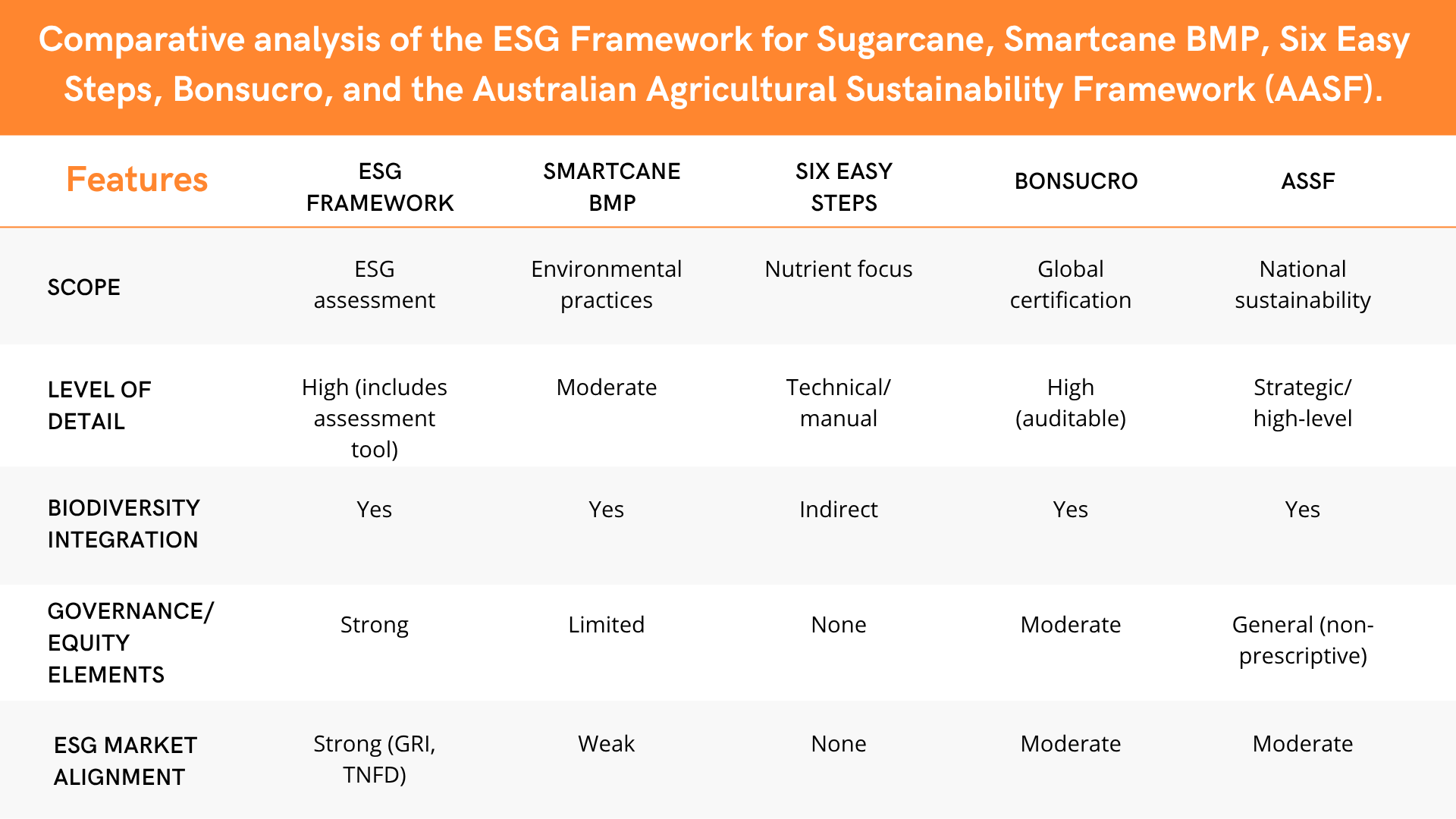
The ESG on-farm framework aims to integrate global sustainability standards with practical, farm-level applications tailored to the Australian sugarcane sector. It fills important gaps left by existing tools by incorporating governance, equity, and financial risk considerations. Unlike conventional practice-based schemes or certification models, this framework provides a flexible and inclusive approach that bridges Smartcane BMP, Six Easy Steps, Bonsucro, and the Australian Agricultural Sustainability Framework (AASF). The result is a unified, market-aligned strategy that supports producers in demonstrating sustainability performance and unlocking new market opportunities.
Why should I use an ESG framework on my property?
Why should I complete an ESG Assessment?
What kind of information do I need to complete the ESG Assessment? How long will it take me to do?
What support is out there to help me complete the assessment?
If you have any questions about ESG or would like help completing your ESG Assessment, please complete the form below or contact TNQ Drought Hub Senior Research Officer and sustainability advocate, Ana Leite De Almeida directly – ana.leitedealmeida@jcu.edu.au or 0402 693 448.
Disclaimer: All the content was built upon existing international and national guidelines, frameworks, and recommendations (e.g., the Global Reporting Initiative (GRI), the Sustainability Accounting Standards Board (SASB), the Task Force on Climate-Related Financial Disclosures (TCFD), the Sustainable Development Goals (SDGs) and the Australian Agricultural Sustainability Framework (AASF). Our effort consisted of adapting those guidelines to make them more “on farm” and easier to be applied by primary producers in Australia.

How ESG and Connectivity Are Shaping Resilient Farms Key takeaway ESG should support better on-farm decisions, help manage risk, and show the real value of good land stewardship, rather than

Climate Smart Agriculture with Reef Catchments Making What You Already Do Work Even Harder Key takeaway Most graziers are already managing natural assets well. Measuring it properly helps you see

ESG and Sustainability goes from the classroom to the coastline Key takeaways Students had the opportunity to see ESG and sustainability in action at Magnetic Island It gave them firsthand