


Research Questions/Objectives:
The aim of this project is to quantify erosion and accretion trends along low energy, embayed tropical coastline on Dawul Wuru Country.
RESEARCH QUESTIONS:
OBJECTIVES:
Brief Description of the Project:
My Honours project reconstructs 80 years of shoreline change along Dawul Wuru Country between Palm Cove and Cairns. By manually geoprocessing historical aerial images between 1943 to 1973, combined with modern satellite data between 1888 to 2025 I will extract shoreline and vegetation line positions to quantify erosion and accretion trends along this low energy, embayed tropical coastline.
These geomorphic changes will be evaluated against construction of catchments and sediment supply, a comparison of extreme rainfall, wind and wave conditions associated with cyclonic events and periods of extended dry seasons associated with drought. My project aims to locate the intersecting retreat zones, bordering culturally significant sites and land used for agriculture such as sugarcane and grazing on Dawul Wuru Country.
The outcome will be an interactive timeline Story Map displaying shoreline response to 80 years of changing climate, it is intended to guide primary producers and Traditional Owner organisations in climate and drought resilience planning. This project has the potential to be applied across multiple low energy headland bay beaches located within tropical cyclone belt regions worldwide.
Background and Significance of the Research Question to drought risk, vulnerability, preparedness, or resilience:
CSIRO State of the Climate 2024 report projects climate change to cause more frequent and severe drought conditions, combined with a shift towards fewer but more intense tropical cyclones with heavier rainfall.
My study site is located within this climatic region and experiences two distinct seasons, a prolonged dry season and a wetter season between November to April providing ideal conditions for tropical cyclone (TC) formation. Culturally significant Indigenous sites, such as middens, fish traps and burial sites are known to occur along these impacted coastlines. Increasingly frequent and intense TCs pose a significant risk to these vulnerable sites through slow onset erosion.
The Barron River coastal floodplains bordering this coastline support sugarcane, grazing within the region. Periods of drought up stream in the Barron River catchment reduces runoff and can alters sediment delivery and water quality to the coast, especially where water is stored or diverted for agriculture and town supply. This may ultimately starve beaches and dunes of sediment, increasing the slow onset erosion of culturally significant Indigenous sites and the vulnerability of low-lying agricultural land and communities to later storm surges. By reconstructing 80 years of shoreline and vegetation line rate of change into multi-year droughts associated with El Nino phases and wetter, cyclone heavy La Nina periods it may provide a better understanding into future drought planning.
Academic and research experience relevant to the honours project:
My academic background combines ecology, remote sensing, climate-related spatial analysis and Indigenous-focused environmental research, all of which are directly relevant to this Honours project and the TNQ Drought Hub priorities.
I have completed a Bachelor of Science at JCU majoring in Ecology and Zoology with a minor in Spatial Science. During my degree I completed a third year Special Research Topic – Enhanced Weathering and Agricultural Landscapes (Spatial Analysis of Enhanced Weathering Potential in Queensland). During this 100% research project I developed and implemented a GIS methodology to identify optimal sites for enhanced weathering as a negative emissions technology. My approach integrated agricultural land use, climate data, soil and geology layers which is similar to how my Honours project integrates coastal geomorphology, climate variability and land use.
My methodology was recognised by my supervisors as a well-developed transferable GIS workflow, and I was invited to co-author future work extending the analysis from Queensland to an Australia-wide scale with Dr Hannah Green and Professor Paul Nelson. This experience shows I can design and deliver spatially specific, climate relevant analyses for agricultural systems, and work productively in a research team.
I then joined the ARC Centre of Excellence for Indigenous and Environmental Histories and Futures (CIEHF) at JCU in March this year as a Casual Research Assistant under the direction of Distinguished Professor Michael Bird. I was responsible for georeferencing historical aerial imagery to investigate long-term environmental change, including geomorphic and vegetation change over time in the Dawul Wuru coastal region allowing me to refine my skills in geoprocessing, interpretation of historical imagery, and change detection across decades. During my employment I presented at Dawul Wuru Workshop and Cultural Heritage Short Course, gaining experience in communicating research with Traditional Owners and integrating cultural perspectives into environmental analysis. This experience demonstrates I have the practical engagement with Indigenous-led research and cultural heritage and aligns with the TNQ Drought Hub’s focus on Aboriginal and Torres Strait Islander resilience and enterprise.
Principal Supervisor’s skills and experience in relation to this project topic:
Distinguished Professor Michael Bird is a Chief Investigator with the ARC Centre of Excellence for Indigenous and Environmental Histories and Futures (CIEHF). His experience in, geochemistry, paleoecology in tropical Australia and Indigenous histories and landscape processes provides ideal guidance for robust methods to detect and interpret coastal change over 80 years and assisting with consultation with Dawul Wuru Aboriginal Corporation through CIEHF’s existing project and broader goals of supporting Indigenous led research.
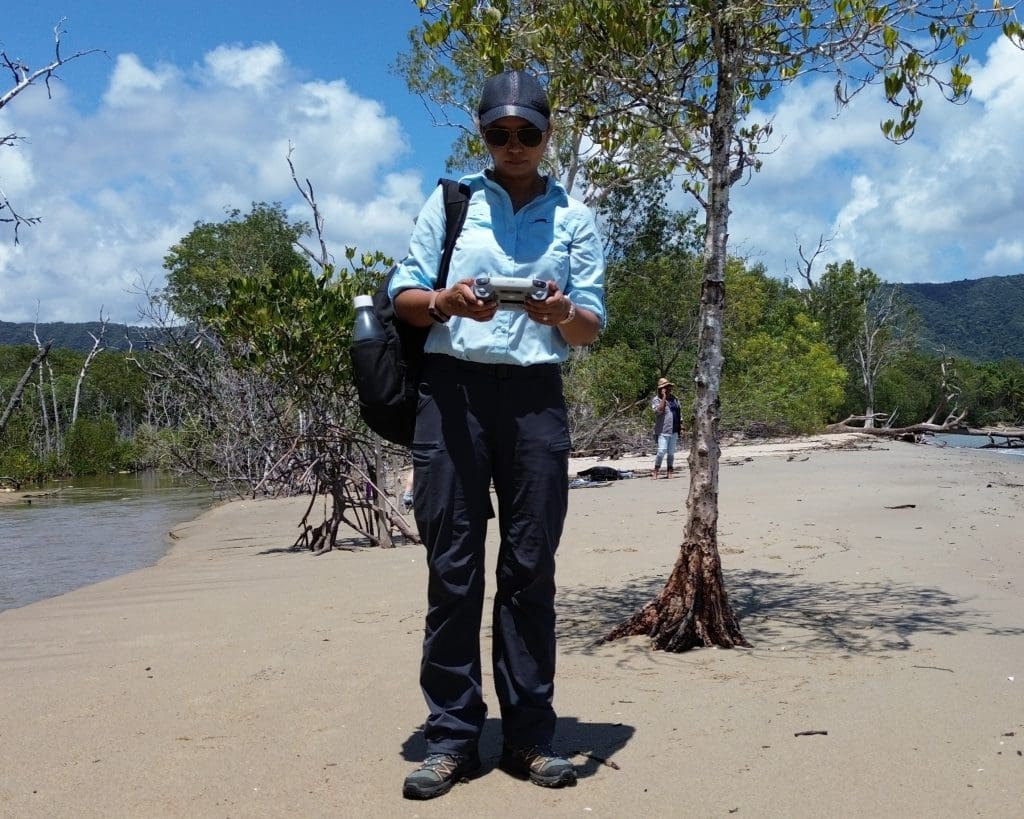
Growing up in Cairns, some of my strongest memories as a child are of Christmas and Easter holidays spent at the beach with my family. The coastline has always felt like home, however I’ve also come to understand how dynamic and vulnerable it is. My family’s connection to the region goes back to my grandfather’s stories of farming sugarcane around Cairns and Gordonvale, so I’ve heard how closely livelihoods and land management are tied to weather.
As a mature-age student, I chose to study because I wanted to turn what I’d observed across my life and work into something practical and useful. Working in remote communities, including the Torres Strait, I witnessed firsthand the reality of coastal erosion and the consequences of flood inundation and the impacts on homes, infrastructure, culturally significant places, and the security of local industries.
That’s why I’m passionate about my Honours research. I’m driven to better understand the processes linking extreme rainfall, cyclones, sediment supply, and coastal change, so communities and decision-makers can plan earlier.
Future Career Goals:
Looking ahead, my goal is to build on this work through a PhD and a career that links research with real-world outcomes to build resilient coastal communities and help safeguard low-lying productive landscapes in Far North Queensland.
To be completed.
To be completed.